
Building a fence around a mature tree in Austin comes down to three rules: leave at least 2 feet of clearance from the trunk, avoid trenching inside the Critical Root Zone (CRZ), and check whether the tree qualifies for protection under Austin’s Heritage Tree Ordinance before you dig a single post hole. Get those three right, and you’ll protect the tree, the fence, and your relationship with your neighbor and your HOA. We’ve installed thousands of fences around mature live oaks, pecans, elms, and cedars across the Austin metro since 2008. Here’s what you need to know before you start, and when it’s worth calling a professional. Ready for a site walk? Request a free estimate, and we’ll come out.
Why Fence Work Around Trees Is Different in Austin
Austin’s tree canopy isn’t just decoration. It’s regulated. Live oaks, monterrey oaks, chinquapin oaks, bur oaks, and pecans over 19 inches in diameter fall under the Austin Heritage Tree Ordinance (Land Development Code 25-8-621 through 25-8-643), which means you can’t damage them without a City Arborist Program review. Cedar elms, cedars, and several other species also carry protection at smaller diameters.
Beyond the ordinance, Austin’s soil makes tree work trickier than most metros. The Blackland Prairie on the east side is dense clay that expands and contracts with every rain cycle, so tree roots spread wide and shallow. Live oak root systems can extend two to three times the canopy width in that soil. On the west side, the Edwards Plateau limestone forces roots even wider because they can’t go down. Either way, digging post holes in the wrong spot doesn’t just risk the tree; it risks the fence: you set a post through a major structural root, the root dies, the soil settles, and your fence starts leaning within a year.
That’s why we treat every fence job with a mature tree in it as a site-planning exercise before a construction one. We’ll walk your yard with you, mark the CRZ, look up whether the tree is protected, and give you an honest read on where the fence line can go.
The Critical Root Zone (CRZ) Rule That Governs Everything
The Critical Root Zone is a circle around the tree, centered on the trunk, that contains most of the roots the tree depends on. Austin’s Environmental Criteria Manual defines it as a radius equal to 12 inches per 1 inch of trunk diameter, measured at 4.5 feet above grade (this is called DBH, or diameter at breast height). A 20-inch DBH live oak has a 20-foot CRZ radius. That’s a 40-foot circle you’re supposed to protect.
The city’s rule is that you can’t disturb more than 25% of the CRZ area on protected trees without a permit. For fences, that usually means you can’t run a trench through it, you can’t compact the soil with heavy equipment, and you can’t cut roots larger than 2 inches in diameter without an arborist sign-off. Post holes are technically allowed if they’re small, spaced, and hand-dug, but the closer you get to the trunk, the more you need to justify each post.
We use hand augers or, in tight spots, a manual post hole digger inside the CRZ. If we hit a root larger than 2 inches, we stop, move the post, and re-plan the fence line. It slows the job down, but it’s the difference between a fence that stands for 20 years and one that leans at year 5 because we killed the root that held the soil.
6 Mistakes Homeowners Make Building a Fence Around a Tree
The mistakes we see over and over on projects that came to us after the first contractor botched them:
- Setting posts too close to the trunk. Anything closer than 2 feet is asking for trouble. As the tree grows, the trunk pushes outward, and the fence gets embedded. We’ve pulled out posts that a live oak had literally grown around.
- Ignoring the Heritage Tree Ordinance. If the tree is protected and you damage it without a review, you’re looking at fines from the City of Austin plus mitigation planting requirements. Check first.
- Using an auger or trencher through the root zone. Mechanical equipment can shred major roots you can’t see. Hand tools inside the CRZ, every time.
- Skipping the arborist consultation on borderline trees. If the tree is close to the 19-inch diameter threshold, have a certified arborist measure and document it. It’s cheaper than the fine if you guess wrong.
- Choosing the wrong material for a root-heavy yard. Solid privacy fence panels channel water toward the fence line, which changes soil moisture around the roots. On yards with shallow roots, an iron or spaced picket often better preserves the tree.
- Cutting corners on post depth. Central Texas clay swells and shrinks. If your posts are shallower than 24 inches (or shorter than one-third the fence height, whichever is deeper), the fence will lean when the soil moves, and you’ll be tempted to blame the tree.
When You Need a Permit or an Arborist Consultation
Within Austin city limits, residential fences under 8 feet typically don’t require a building permit, but tree-adjacent work is an exception. If your fence line runs inside the CRZ of a protected tree (heritage or otherwise), you need a City Arborist Program review before you start. Our Austin Heritage Tree Ordinance workflow walks through the protected species list, the arborist consultation process, and what to expect from the review.
Outside city limits (Buda, Manor, Kyle, Dripping Springs), the rules loosen but don’t disappear. Hays County and Travis County both have heritage tree protection frameworks tied to development permits, and HOA architectural review committees often carry stricter tree rules than the county. Check your local permit requirements before you dig.
Fence Materials That Work Best Around Mature Trees
Not every fence material is tree-friendly. Here’s what we’ve learned from installing fences around live oaks, pecans, and mature cedars across the Austin metro:
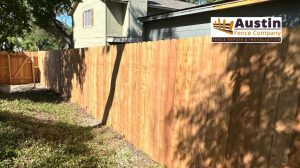
Cedar privacy fence is our most common recommendation for tree-adjacent yards. Cedar is naturally rot-resistant, so the wet soil that gathers near roots doesn’t destroy it as fast as pressure-treated pine. It also flexes with soil movement, which matters when clay swells and shrinks around root systems. Six-foot board-on-board is our standard around trees where privacy matters.
Ornamental iron fencing works well around trees when you want visibility, and when the tree canopy needs airflow. Iron doesn’t block wind the way a privacy fence does, so the tree’s crown isn’t stressed. It’s also easy to route iron around a trunk in a curved section. Iron is our recommendation for front-yard fences near heritage trees when you want to preserve sightlines.
Chain link with vinyl coating is a budget-friendly option that’s genuinely tree-friendly. It’s permeable to water and airflow, and it’s the easiest material to adjust if you have to move a section around a root. Not everyone loves the look, but for back-of-lot or pool enclosures around trees, it’s the practical choice.
What we don’t recommend around mature trees: solid vinyl fence panels (they trap moisture against the roots), composite panels with concrete post bases (concrete inside the CRZ is a mitigation trigger under the ordinance), and any fence design that requires trenching for a bottom rail.
HOA Architectural Review Workflow for Tree-Adjacent Fences
Almost every Austin metro neighborhood built in the last two decades has an HOA architectural review committee, and most of them have tree-specific fence rules on top of city ordinance requirements. Steiner Ranch’s ARC rules govern live oak preservation throughout the community. Circle C requires site plans that mark every tree with a DBH over 6 inches. Sunfield in Buda has a fast Sunfield ARC workflow, but rejects any fence that runs within 8 feet of a mature oak trunk without an arborist letter.
The workflow that works: measure the tree, calculate the CRZ, draft the fence line at least 2 feet beyond the CRZ boundary, take photos from three angles, and submit before ordering materials. On approved brands like Sunfield and Ranch at Brushy Creek in Cedar Park, the ARC turnaround is 2 to 4 weeks. On slower committees, it can be 6 weeks. Build that into your timeline, or you’ll be sitting on a stack of cedar pickets waiting for a letter.
When to Call a Professional
Building a fence in an open, treeless yard is a reasonable DIY project. Building a fence around a mature tree in Austin, particularly a heritage tree, is where the risk no longer matches the reward. You’re weighing a couple of days of labor savings against a possible city fine, a mitigation planting requirement, an HOA rejection, and a dead tree three years from now if you nick the wrong root.
Since 2008, we’ve installed fences around mature trees on hundreds of Austin metro projects. We’re fully insured on every job, we carry a written 1-year workmanship warranty, and we’ve got 134 verified Google reviews averaging 4.9 stars. We’ll handle the CRZ measurement, coordinate the arborist if needed, submit the HOA package, and build a fence that respects the tree. Get a site walk from our team, and we’ll come out.