
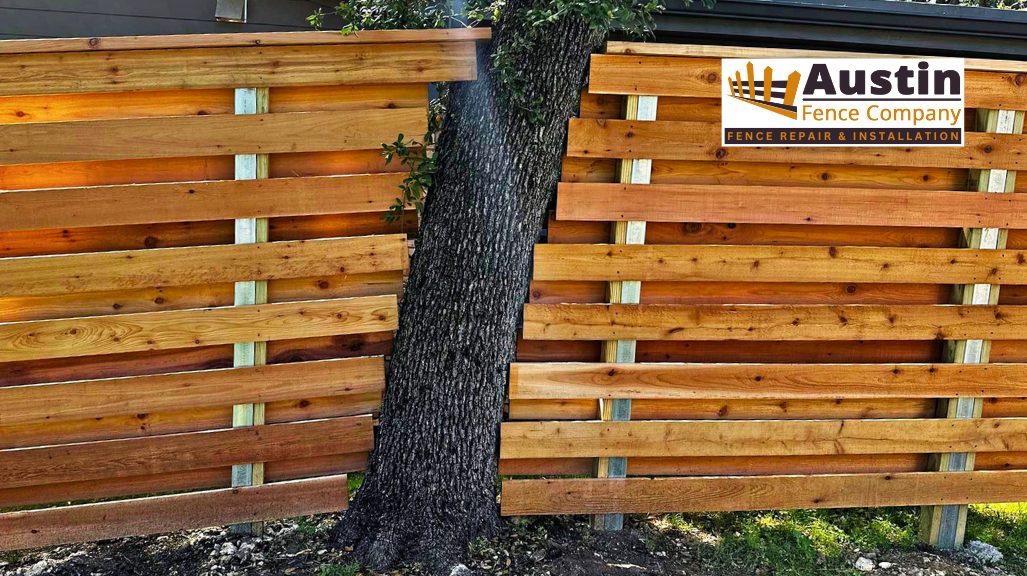
Austin’s Heritage Tree Ordinance (Land Development Code 25-8-621 through 25-8-643) protects six tree species over 19 inches in diameter, and it applies to your fence job the moment your fence line crosses the tree’s Critical Root Zone. Damage a protected tree without a City Arborist Program review, and you’re looking at fines plus mitigation planting. This guide walks through which trees qualify, how the review actually works, and how we handle the paperwork end-to-end. Ready for a tree survey and fence plan? Request a free estimate, and we’ll come out.
What the Austin Heritage Tree Ordinance Protects
The Heritage Tree Ordinance was written into Austin’s Land Development Code to preserve the mature native canopy that defines the city’s character. It restricts activities that damage protected trees, and “damage” is defined broadly enough to include cutting roots larger than 2 inches, compacting soil inside the Critical Root Zone, and installing hardscape (including fence posts and footings) that alters drainage or root respiration.
The ordinance is located in Chapter 25-8, Article 6 of the Land Development Code. The technical measurement standards are set out in the Environmental Criteria Manual, Section 3. If you want to read the source language, both documents are on the City of Austin’s tree preservation page. If you just want to know whether your fence job triggers the ordinance, keep reading.
Which Species Qualify at Which Diameters
Six tree species are protected under the Heritage Tree Ordinance once they reach 19 inches in diameter, measured at 4.5 feet above grade (this is called DBH, or diameter at breast height):
- Live oak (Quercus virginiana and Quercus fusiformis)
- Monterrey oak (Quercus polymorpha)
- Chinquapin oak (Quercus muehlenbergii)
- Bur oak (Quercus macrocarpa)
- Pecan (Carya illinoinensis)
- Cedar elm (Ulmus crassifolia), protected at 24 inches DBH for cedar elm specifically
A separate protected tree category covers a broader set of native species at 19 inches DBH under Article 25-8-622. Some species carry protection at smaller sizes inside specific neighborhood overlays. When we do a site walk, we measure every tree that looks close to threshold and note the species so nothing gets missed later.
The Environmental Criteria Manual CRZ Formula
The Environmental Criteria Manual (ECM), Section 3, defines the Critical Root Zone as a circular area centered on the trunk, with a radius equal to 12 inches for every 1 inch of DBH. A 25-inch DBH live oak has a 25-foot CRZ radius, so you need to plan a 50-foot diameter circle around.
The city allows disturbance of up to 25 percent of the CRZ area on protected trees without a permit. For a fence job, that percentage almost never becomes the limiting factor. What matters more is the specific activities the ordinance prohibits inside the CRZ: trenching, heavy equipment operation, soil compaction, and cutting roots larger than 2 inches without an arborist sign-off. Post holes are permitted if hand-dug and spaced to avoid major roots.
Our main fence around tree guide covers the practical construction techniques for CRZ work. This spoke focuses specifically on the ordinance and review process.
How the City Arborist Program Review Works
If your fence work will disturb any part of a protected tree’s CRZ, you need a City Arborist Program review before you break ground. The review is housed within the Development Services Department and follows a defined submission workflow.
Step one: a tree survey. It’s a site drawing showing every tree over 8 inches DBH within the project area, with species, DBH, and CRZ radius marked. A certified arborist prepares this document; we coordinate with our arborist partners on every ordinance-triggered job.
Step two: a preservation plan. This document shows the proposed fence line overlaid on the tree survey with distances to each CRZ boundary noted. It also documents any proposed encroachments (post holes within the CRZ, for example) and the mitigation techniques we’ll use (hand-digging, root-pruning limits, air-spading around larger roots).
Step three: submission and review. The tree survey plus preservation plan gets submitted to the Development Services Department’s arborist review queue. Review turnaround is typically 2 to 4 weeks. If the reviewer requests changes, we revise and resubmit. Once approved, the review letter authorizes the fence work.
Fines and Mitigation Planting
Damaging a protected tree without a review triggers enforcement action from the City Arborist Program. The consequences fall into three categories.
Fines are calculated per inch of damaged trunk diameter. A significant fine for even minor damage to a large heritage tree adds up quickly.
Mitigation planting is the requirement to replace lost canopy with new tree plantings, calculated in inches of replacement caliper. Damaging a 25-inch heritage live oak might require planting many caliper inches of replacement trees. That gets expensive fast, since they’re typically 2- to 3-inch calipers each.
Stop-work orders and permit holds can freeze the entire project until compliance is documented. On active construction jobs, this compounds costs due to delayed timelines.
How We Handle the Ordinance Workflow
On any fence job with a protected tree on the property, we treat the ordinance workflow as part of the scope from day one. Since 2008, we’ve handled dozens of Heritage Tree Ordinance-triggered projects across the Austin metro. Our process:
During the initial site walk, we identify every tree that appears to be within the protected threshold and measure its DBH on the spot. If there’s any question about whether the ordinance applies, we’ll recommend engaging a certified arborist before the design work goes further.
When ordinance applies, we’ll coordinate with our arborist partners to produce the tree survey and preservation plan. We’ll prepare the fence design to minimize CRZ encroachment and set expectations with the homeowner about the timeline and cost.
We’ll handle the review submission and any follow-up requests from the city. Fence construction starts only after the review letter is in hand. During the build, we’ll use hand augers or manual post-hole diggers in every CRZ, and we’ll stop work if we encounter unmarked roots larger than 2 inches, at which point we’ll consult an arborist.
We’re fully insured on every job, we carry a written 1-year workmanship warranty, and we’ve earned 134 verified Google reviews averaging 4.9 stars. If you have a heritage tree on your property and a fence job in mind, get a site walk from our team before the design work goes further.